Collagen is the body's main structural protein. It forms a strong, flexible network in skin, bones, tendons, cartilage and blood vessels, and your body makes its own from the amino acids in the protein you eat.

What collagen does in your body, the different types, what you can and can't claim about supplements, and how to choose a good one.

Collagen is the body's main structural protein. It forms a strong, flexible network in skin, bones, tendons, cartilage and blood vessels, and your body makes its own from the amino acids in the protein you eat.
Think of collagen as the scaffolding of your body. It's a fibrous protein that forms a strong, flexible network throughout your tissues. Made primarily from three amino acids—glycine, proline, and hydroxyproline—collagen molecules twist together like rope to create incredibly strong fibers that can withstand tension and pressure.
These collagen fibers are organized in different patterns depending on where they're located in the body, allowing them to perform specific functions—from providing stretchy support in skin to creating rigid structure in bones.
Collagen is distributed throughout your entire body, as a structural protein in multiple systems and tissues. Here's where you'll find it and what it does:
Collagen fibres make up most of the dermis, the layer of skin under the surface, giving it structure and strength.
Gives structure and strength to bones. Collagen provides the framework that calcium and other minerals attach to, making bones both strong and flexible.
Collagen is a main part of cartilage, the tissue that cushions the ends of bones where they meet at a joint.
Collagen gives structure to the tissue around muscles and makes up most of the tendons that connect muscles to bones.
Collagen is part of the walls of blood vessels, helping them keep their shape. Vitamin C contributes to normal collagen formation for the normal function of blood vessels.
Hair and nails are made mainly of keratin, not collagen. Biotin and zinc contribute to the maintenance of normal hair, and zinc to the maintenance of normal nails.
Scientists have identified at least 28 different types of collagen in the human body, each performing specific functions in different locations. The most important types for health and wellness include:
Most abundant type - Found in skin, bones, tendons and connective tissue. It's the main type in skin and bone.
The cartilage type - Primarily found in cartilage and the eyes.
Found alongside Type I - In skin, blood vessels and internal organs.
Your body naturally produces collagen throughout your life, but this production begins to slow down as early as your mid-20s. By age 30, most people experience a significant decline in collagen production, which accelerates with each passing decade.
Several lifestyle and environmental factors can speed up collagen breakdown and reduce production:
Collagen is the most abundant protein in the human body, making up approximately 30% of all proteins. Often called the body's "building blocks" or "glue," collagen provides the structural foundation that holds our body together, giving us strength, flexibility, and resilience.
Collagen is a complex protein made up of long chains of amino acids, primarily glycine, proline, and hydroxyproline. These amino acids form a unique triple-helix structure that gives collagen its remarkable strength and flexibility. This structure allows collagen to resist stretching and compression while maintaining its integrity under various conditions.
The word "collagen" comes from the Greek word "kólla," meaning glue, and "gen," meaning producing. This name perfectly describes collagen's role as the body's natural adhesive that holds tissues together.
Collagen is composed of several key components that work together to create its unique properties:
The building blocks of collagen, with glycine making up about one-third of all amino acids in collagen. Proline and hydroxyproline provide the structural stability.
Three polypeptide chains twisted together like a rope, creating a strong, flexible structure that can withstand tension and pressure.
Chemical bonds between collagen molecules that provide additional strength and stability to tissues.
Collagen molecules that bundle together to form larger structures called fibrils, which then organize into fibers.
In the human body, collagen is produced by specialized cells called fibroblasts. These cells synthesize collagen molecules and secrete them into the extracellular matrix, where they assemble into the structural framework of tissues.
For supplementation, collagen is typically sourced from:
Your body's own collagen production slows as you get older. A collagen supplement is a simple way to add hydrolysed collagen peptides, which are also a good source of protein, to your daily diet. People take them because:
Some everyday factors are linked to faster collagen breakdown in the skin, including:
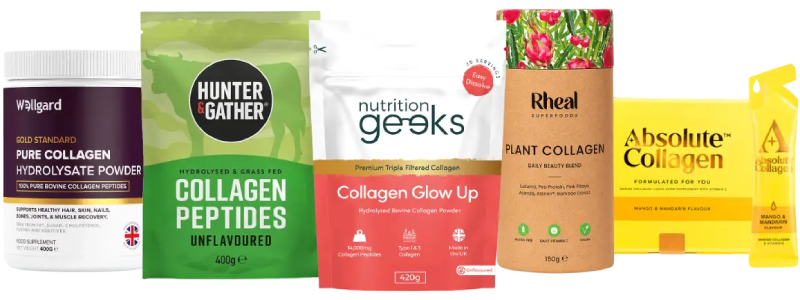
Short on time? Here's how the collagen supplements we compared rank, and who each one suits best.
We checked each product against the five things that matter most in a collagen supplement. Details come from each brand's own label and website.
| What we checked | #1Nutrition Geeks | #2Wellgard | #3Hunter & Gather | #4Rheal | #5Absolute |
|---|---|---|---|---|---|
| At least 10g of collagen per serving | ✓ | ✓ | ✓ | ✗ | ✗ |
| Hydrolysed collagen peptides | ✓ | ✓ | ✓ | ✗ | ✓ |
| No sweeteners, sugars or flavourings | ✓ | ✓ | ✓ | ✗ | ✗ |
| Under £1 per serving | ✓ | ✓ | ✓ | ✗ | ✗ |
| Free next day delivery | ✓ | ✗ | ✗ | ✗ | ✓ |
| Price per serving | 57p | 64p | 98p | £1.33 | £2.43 |
| Checks passed | 5/5 | 4/5 | 4/5 | 0/5 | 2/5 |
Swipe sideways on mobile to see every product.
Every product gets a score out of 10 for 5 criteria. Each criterion is weighted by how much it matters to someone buying collagen, and the weighted scores add up to the overall score you see on each review. We base scores on the product label, the brand's list price, delivery terms and verified customer reviews. The letter grade follows the score: A+ is 9.5 or more, A is 9.0, B+ is 8.0, and so on.
Grams of hydrolysed collagen peptides per serving, compared with the 2.5g to 15g range used in most published studies, and the collagen types used.
Whether the label is collagen only, or adds sweeteners, flavourings, sugars or fillers you don't need.
Price per serving at the current list price, and price per gram of collagen.
How easily it dissolves in hot and cold drinks, and what customers say about smell and taste.
Verified customer reviews, where it's made, delivery speed and cost, and returns.
Four things separate a good collagen supplement from an expensive one.
Most published studies use 2.5g to 15g of collagen peptides a day. Check how many grams of collagen you get per serving, not per pack. Capsules often contain under 1g each, so you'd need a handful a day to match one scoop of powder.
"Hydrolysed" means the collagen has been broken down into peptides that dissolve easily. Type I and Type III are the main types found in skin. Bovine collagen provides both, and marine collagen is mainly Type I.
The best powders list one ingredient: collagen peptides. Sweeteners, flavourings and sugars add cost and make the powder harder to use in savoury food or coffee. Better filtering also means less smell and taste.
A cheap tub with small servings can cost more per day than a bigger one. Divide the price by the number of full servings. Across our top five, the price ranged from 57p to £2.43 per serving.
Turn the pack over before you buy. The front sells the product; the back tells you what's in it.
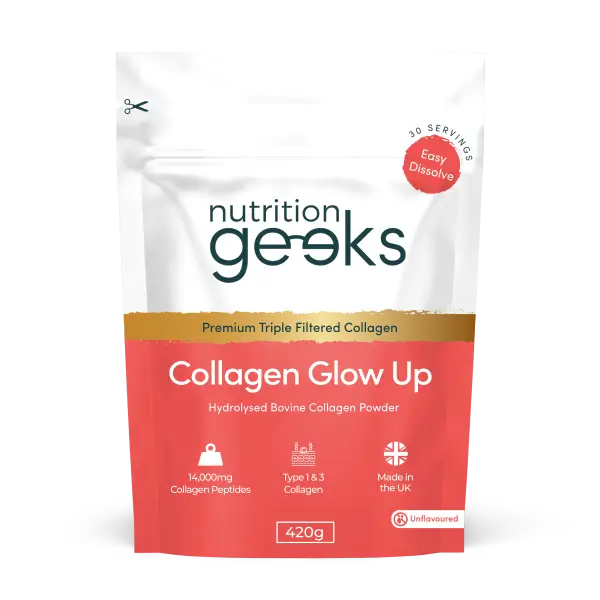
Nutrition Geeks Collagen Glow Up is our top pick because it wins on the two things that matter most in a collagen powder: how much collagen you get per serving and what each serving costs. At 57p for 14g it's cheaper than every other product we compared, and the label is a single ingredient. It's over 90% protein, and protein contributes to the maintenance of muscle mass and normal bones. The only real downsides are that it's online-only and not vegan.
✓ Free Next Day Delivery · ✓ 110,000+ Trustpilot reviews
Wellgard is a solid, single-ingredient bovine collagen made in the UK, with a generous 13g serving. It loses out to our top pick on price per gram at full price, and on delivery, which costs £2.90 unless you spend £30.

Verdict: A clean label and a big 13g dose, but at 98p a serving it costs about 70% more than our top pick.
Shop Hunter & Gather
Verdict: Tastes good and suits vegans, but it's a plant blend with no collagen in it.
Shop Rheal
Verdict: Handy sachets, but £2.43 for 8g of collagen with sweeteners is poor value.
Shop Absolute CollagenOur top two are both UK-made bovine collagen powders with no additives. Here's where they differ.
| Category | Nutrition Geeks | Wellgard | Winner |
|---|---|---|---|
| Price per gram of collagen | 4.0p | 4.9p | Nutrition Geeks |
| Collagen per serving | 14g | 13g | Nutrition Geeks |
| Collagen type | Type I & III | Type I & III | Tie |
| Additives | None | None | Tie |
| Made in the UK | Yes | Yes | Tie |
| Delivery | Free Next Day Delivery | £2.90 under £30 | Nutrition Geeks |
| Subscribe & save | 10% off | 15% off | Wellgard |
Collagen supplements typically provide 2.5 to 15 grams a day. Most published studies use between 2.5g and 10g a day, and some use up to 15g. There is no official recommended intake for collagen in the UK, so follow the serving size on the label.
While foods like bone broth, fish skin, and chicken contain collagen, getting adequate amounts from diet alone can be challenging. Natural collagen production also decreases with age, starting from our mid-20s. Additionally, modern food processing methods often remove collagen-rich parts of animals, so a supplement is a simple way to get a measured amount each day.
Collagen is the most abundant protein in the body, making up about 30% of total protein content. It is a structural protein found in skin, bones, tendons, cartilage and ligaments. Your body makes its own collagen, and production slows with age. Vitamin C contributes to normal collagen formation for the normal function of skin and blood vessels.
Collagen deficiency isn't something a UK doctor would normally diagnose. Your body makes collagen from the protein you eat, and production naturally slows with age. Getting enough protein and vitamin C matters, because vitamin C contributes to normal collagen formation for the normal function of skin. If you have a health concern, speak to your GP or pharmacist.
Collagen supplements can be taken any time of day, but consistency is key. Some people prefer taking it in the morning on an empty stomach, while others take it with meals. Vitamin C contributes to normal collagen formation for the normal function of skin, so it's worth getting enough vitamin C too. The most important factor is finding a routine that works for you and sticking to it.
Collagen is generally considered safe, and there is no established upper limit for intake. However, as with any supplement, it's best to follow the recommended dosage on your product. Some people may experience mild side effects like bloating or a feeling of fullness if taking large amounts. If you have specific health conditions or concerns, consult with a healthcare provider about the right dosage for you.
Rebecca researches and writes our supplement comparisons. For each guide she reads the product labels, checks list prices and delivery terms, reads verified customer reviews, and checks health wording against the GB register of approved claims.
These sources describe how collagen works in the body and the doses used in research. They are not evidence for any specific product.

Nutrition Geeks Collagen Glow Up scored the highest of the five collagen supplements we compared. Each 420g pouch gives you 30 servings of 14g triple-filtered hydrolysed bovine collagen, with nothing else added.
At 57p per serving it was also the best value we found, and it's made in the UK and sourced from grass-fed, pasture-raised cattle.
MADE IN THE
UNITED KINGDOM
FREE NEXT
DAY DELIVERY
RATED EXCELLENT
ON TRUSTPILOT
✓ Free Next Day Delivery · ✓ 110,000+ Trustpilot reviews
Get our #1 Ranked Collagen Powder from Nutrition Geeks from only £16.99 £19.99

